
Members only
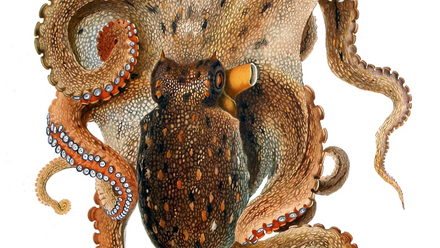
A strange creature, with shadows pulsing across its indeterminate form, sat hunched on the seabed above eight tentacles and among sea fans and sponges. This was clearly an octopus, but it was much larger than the species normally found in UK waters, and something was different about it. As the diver approached, it lifted off the seabed to reveal the claws and antennae of a lobster in its grip, which flapped feebly as the octopus injected its venom and swam off in a cloud of ink, no doubt to consume its prize in solitude.
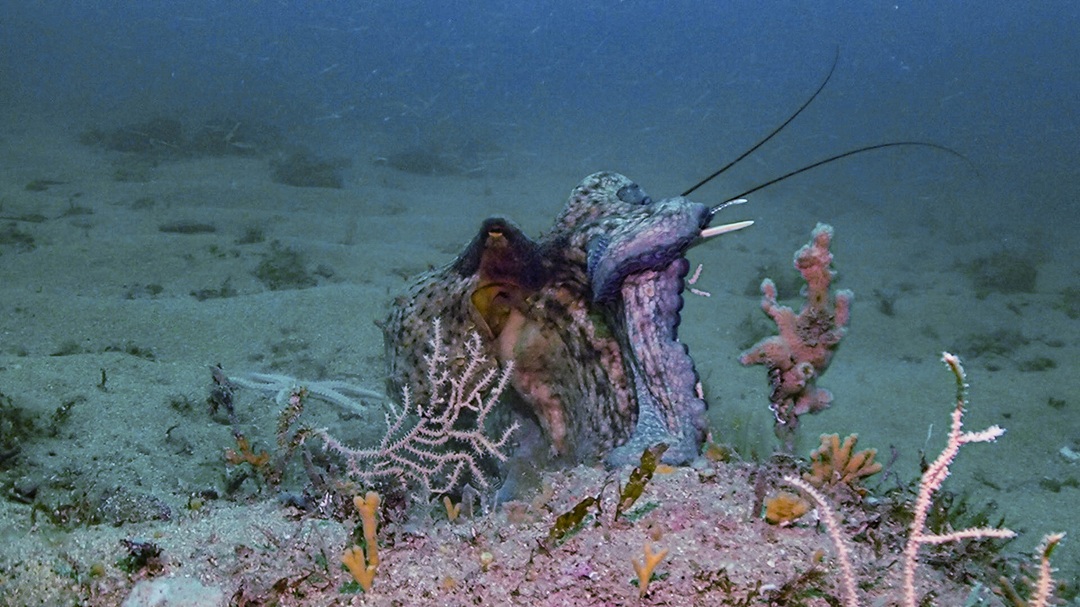
A screen grab from footage of a common octopus dispatching a lobster off Plymouth, UK. © Olivia Langmead.
This was the scene filmed by one of us at the Mewstone off Plymouth last October, and it encapsulated the bloom of octopus off the south-west UK coast in 2025, in all its complexity. The species in the frame was the common octopus, Octopus vulgaris, although it is not normally common in British waters, instead preferring the warmer climes of southern Europe, the Mediterranean and the north coast of Africa. But in 2025, numbers of common octopus exploded off the south-west coast of the UK in a phenomenon not previously seen since 1950 and only recorded twice in history before that.
A new project, led by the Marine Biological Association in collaboration with Plymouth Marine Laboratory (PML) and the University of Plymouth and funded by DEFRA, Plymouth City Council, and Devon County Council, is unravelling the mystery behind why these octopus blooms occur and the effects they are having on marine ecosystems and fisheries.
Not surprisingly, there is a link with climate change. During both this year and the years of the previous octopus blooms, the seawater temperature has been unusually warm compared to the average at the time. But much of last year and the year before took things to new levels, with temperatures being classified as a ‘marine heatwave’. Modelling of ocean currents by scientists at PML has also suggested that baby octopus arrived on our shores in the plankton after hatching in places like the Channel Islands and the northern coast of France.
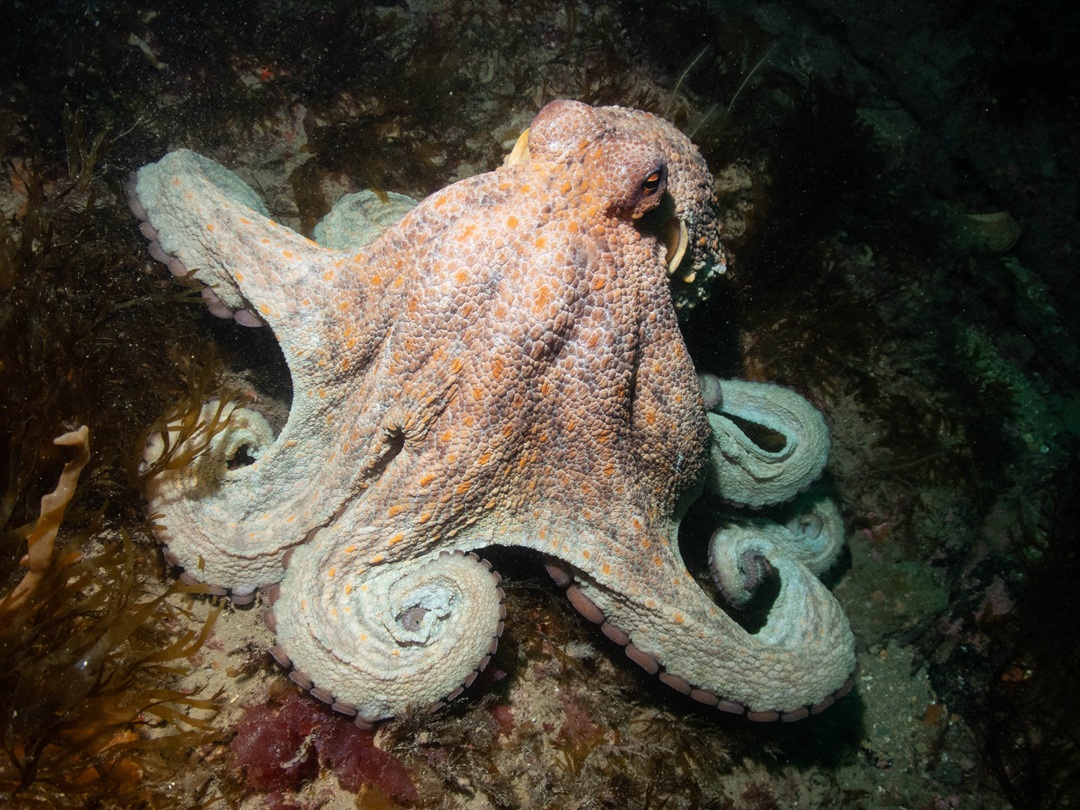
But while divers have marvelled at the sight of these strange, beautiful, intelligent, and previously rare creatures, the reaction of the fishing industry has been mixed. The first sign of these octopus was the effects of them raiding fishermen’s shellfish pots, just leaving the odd lobster claw or hollowed out crab carapace. But fishermen are nothing if not innovative, with some starting to target octopus directly for the lucrative export market. However, while some fishermen made good money for a while, catches of their traditional species such as brown crabs, lobsters, and scallops dropped off by as much as 50 per cent in 2025, presumably due to octopus predation. With octopus numbers dropping off in winter as well, many fishermen are now left with very little to catch at all.
So what does the future hold? Given the link with climate change, and reports from both divers and fishermen of octopus breeding, along with the recent appearance of young octopus, it seems likely that they are now here to stay. This is just one more example of how the ocean is rapidly changing, but it also highlights how scientific understanding can help us both predict and adapt to a transforming underwater world.
Dr Bryce Stewart (bryste@mba.ac.uk), Senior Research Fellow at the MBA and Associate Professor at the University of Plymouth.
@bd-stew.bsky.social
linkedin.com/in/bryce-stewart-9aa9bb31/
Dr Olivia Langmead (olivia.langmead@gmail.com)
linkedin.com/in/olivia-langmead-38b54141
A new report examining the phenomenon of octopus blooms is available here.
Stewart, B.D., Thomas, S., Smyth, T.J., James, M.K., Sullivan, E., Hall, A.E., Osmond, T. and Sheehan, E.V. 2026. Common octopus (Octopus vulgaris) blooms off the Southwest of the UK: History, trends, causes and consequences. Report on Work Package 1: History, causes and consequences of octopus blooms. Marine Biological Association, 104pp.