Tico, the meandering manatee
This is the story of Tico the manatee. Before we dive into the details of his great adventure, let’s first go back to 1994. That year, a group of students from Ceará, Brazil, founded Aquasis, an NGO dedicated to studying aquatic mammals.[1] They began rescuing stranded manatee calves and specializing in their rehabilitation, since strandings have increased over time along Brazil’s semi-arid coast. For example, in 2024 alone, six stranded manatee calves were recorded in Ceará.
Tico was one of the lucky manatees rescued in 2014, thanks to a report from one of the NGO’s collaborators. He was found stranded near another newborn manatee on Agulhas Beach, Fortim, Ceará. Genetic studies later confirmed that this other manatee was his twin brother, Teco (Figure 1). Their names were inspired by the Portuguese names of the chipmunks in the Disney cartoon Chip ‘n’ Dale.
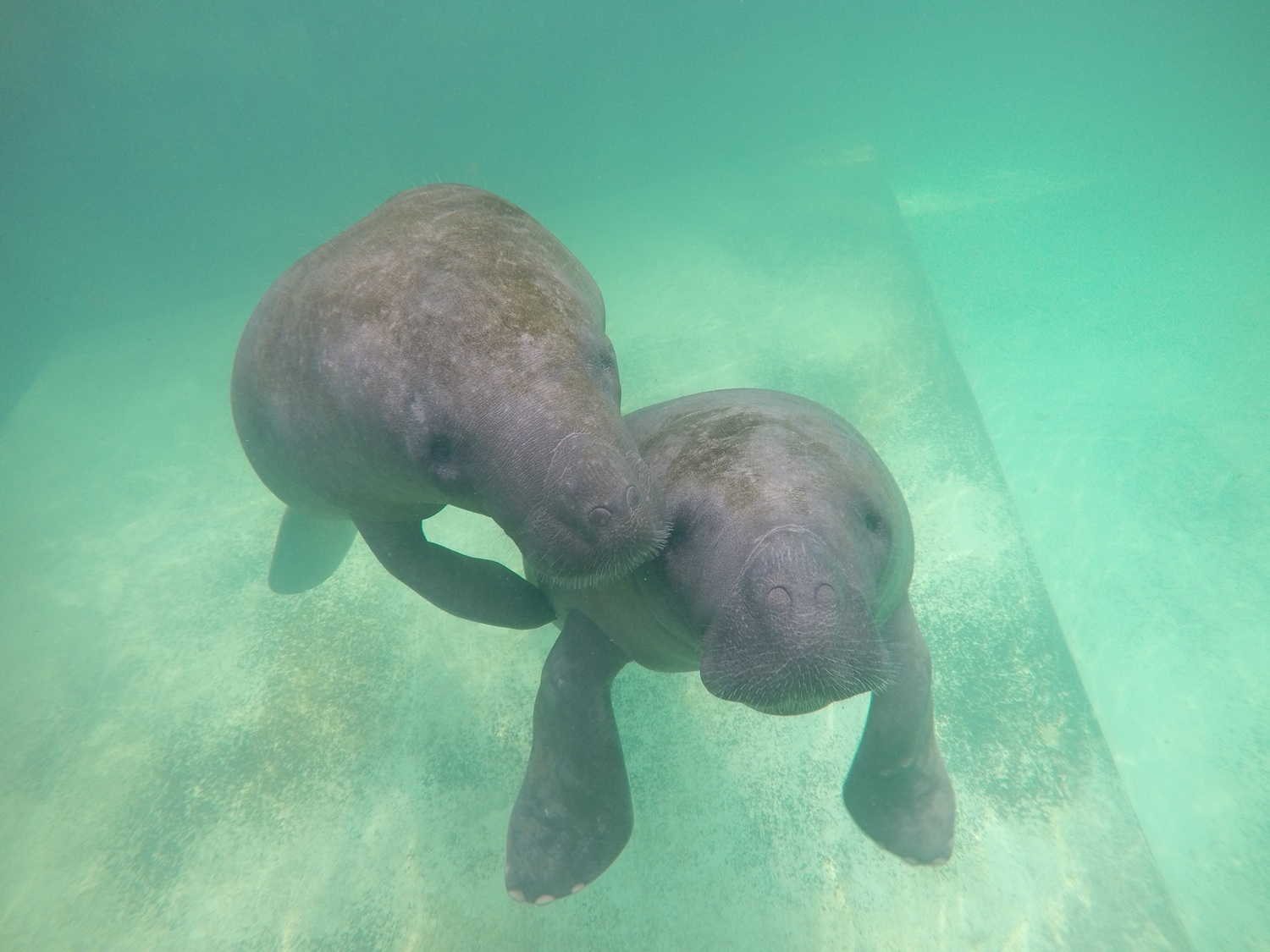
The twins were transported to the Aquasis Marine Mammal Rehabilitation Centre (MMRC), where they remained in rehabilitation.
In 2019, Aquasis built a new floating enclosure in a marine environment to help manatees adapt to ocean conditions before their release—the ultimate goal of rehabilitation. The Brazilian manatee population is estimated to be around 1,000 individuals, making the release of rescued calves essential for the species' conservation.
The Brazilian manatee population is estimated to be around 1,000 individuals, making the release of rescued calves essential for the species' conservation
So, in December 2020, at the age of 7 years and 2 months, Tico was moved to this enclosure, where he stayed for 18 months.
Releasing Tico
Tico was released into the wild on Peroba Beach, Icapuí, on 6 July, 2022. For the first few days after his release, Tico stayed in the Icapuí region, where food resources are abundant and a resident manatee population exists. However, he soon began moving westward, following Ceará’s coastal currents, which are primarily driven by wind patterns.
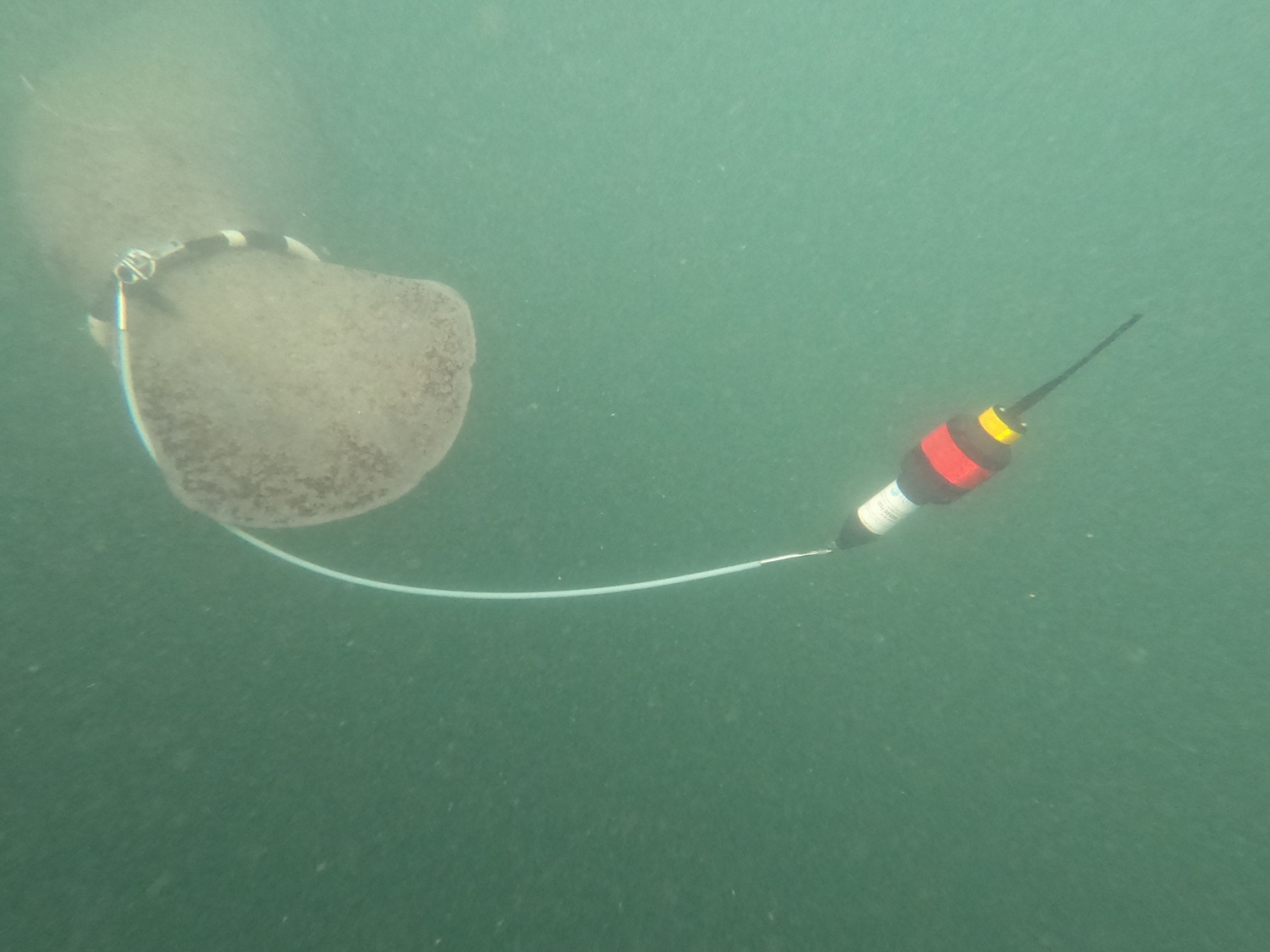
The tracking equipment consists of a belt attached near the animal’s paddle, connected by a tether to a buoyant radio tag (Fig. 2). The tether and tag can detach as a safety measure to prevent entanglement.
About 10 days after his release, Tico ventured offshore, moving away from the coast. The monitoring team planned a boat trip, but before they could reach him, he returned on his own. The next day, Tico became trapped in a fishing corral and was rescued with the help of local fishers. Fortunately, he was in good condition and was promptly released again.
Tico resumed his westward movement and soon started heading into deeper waters, this time moving further and further from the coast and beyond the edge of the continental shelf. Monitoring in this region requires additional safety measures, and, even with the Navy’s support, the team struggled to find vessels capable of travelling so far offshore.
Determined to track the manatee, a team of six people in two cars followed his movements by land, stopping at ports in different cities in search of a suitable vessel. Their journey spanned five Brazilian states, covering an impressive 2,000 kilometres. When they reached the land border between Pará and Amapá—an area with no road access—part of the team flew to Amapá.
At this point, uncertainty began to set in. Had Tico’s tracking device detached and drifted away, or was he truly in that region? Despite the doubts, the coordinates strongly suggested the latter.
The team contacted the Tactical Air Group of Amapá, which agreed to assist in the mission. The plan was to conduct an aerial survey over the sea near Oiapoque, Brazil’s northernmost point. The team flew in a small plane from Macapá to Oiapoque, but upon arrival, they realized the survey would not be possible. The projections had suggested Tico would pass closer to the coast, but instead, he had moved farther offshore, following the vortices of the North Brazil Current (Fig. 3 b). The aircraft lacked the fuel capacity to complete the flight, so the team had to return without confirming whether Tico was in the area.
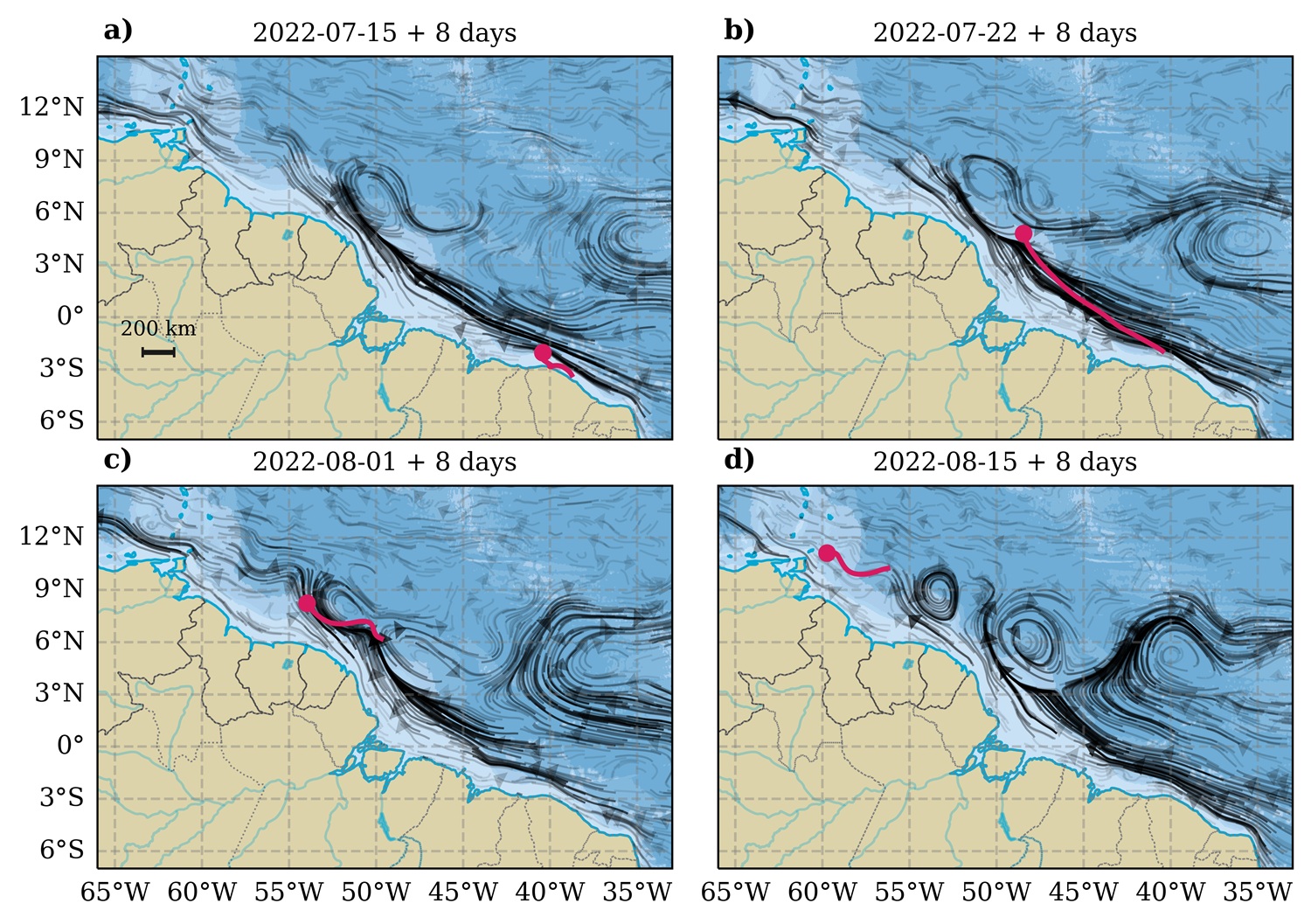
In the following days, Tico crossed Brazil’s border into French Guiana. He continued travelling westward, and our analysis showed that his speed closely matched that of the North Brazil Current. His trajectory also followed the current’s vortices, forming curves along the way (Fig. 3c).
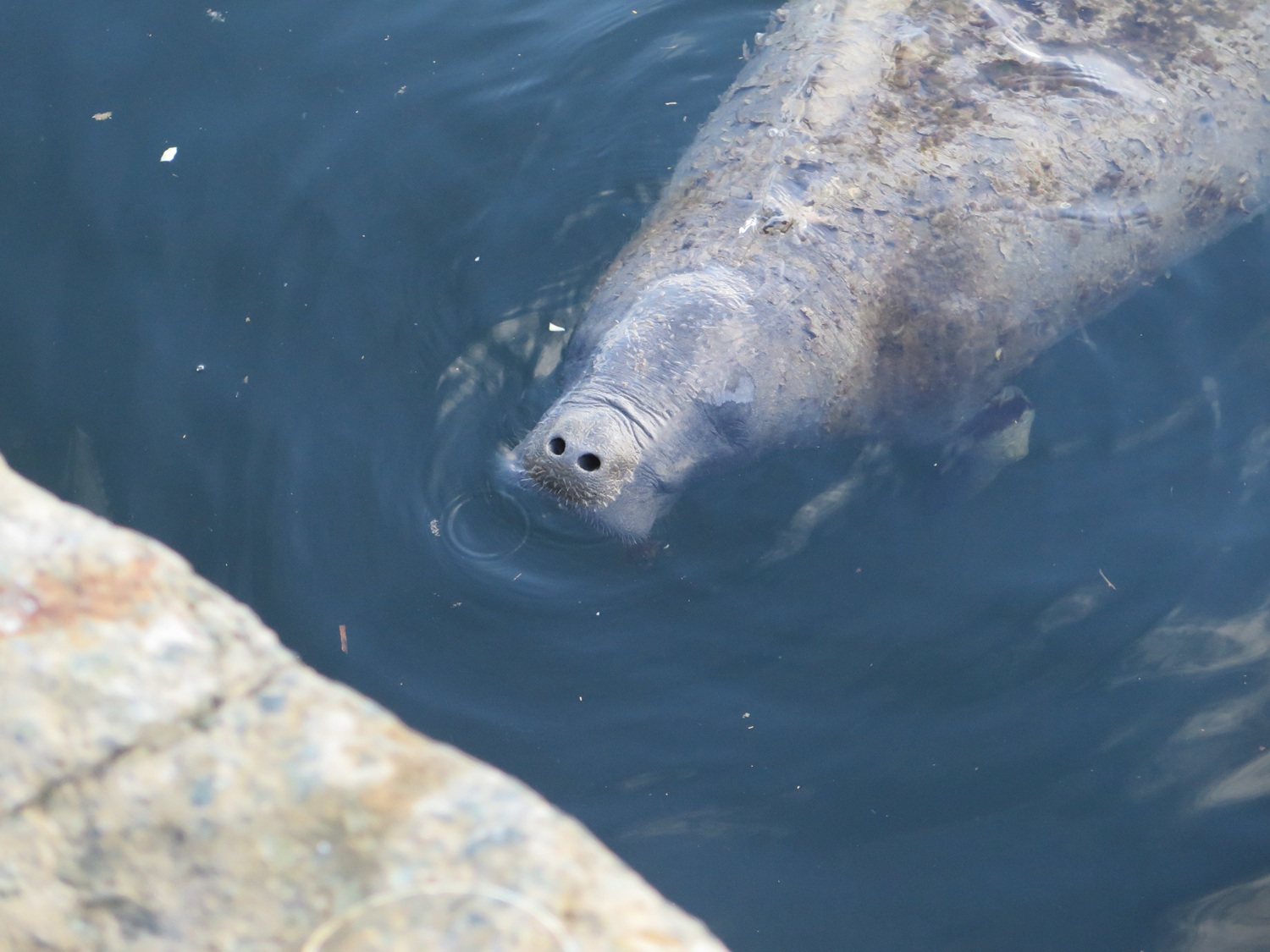
By the end of August, the coordinates indicated he was approaching the island of Tobago. Researchers from the region were contacted and assisted in the search. They contacted local fishers, who checked the reported coordinates and spotted Tico swimming towards the coast. He stayed near the island for a few days and was seen by the local population at the Port of Scarborough (Fig. 4). However, before the team could arrive, he continued his journey toward Venezuela (Figure 3d).
At this point, the team was in contact with the Caribbean Stranding Network, and thanks to this collaboration, several institutions in Venezuela coordinated efforts to rescue Tico. Given his extraordinary journey—over 4,000 km—a veterinary evaluation was necessary to assess his body condition and overall health.
It is believed that during his deep-water journey, where seagrasses (his main food source) were unavailable, Tico may have fed on Sargassum, as large floating mats of this algae exist in the region. Additionally, he had eaten near Tobago’s coast, as confirmed by faecal analysis after his capture in Venezuela.
Manatees need to drink fresh water regularly, so we analysed the regions Tico traveled through to determine whether heavy rainfall had occurred. We found that strong storms had occurred at certain points along his route, which may have provided him with fresh water.
Studying Tico’s trajectory is important for guiding future releases, understanding these animals’ movements, and how manatees manage to survive travelling into deep waters. We hypothesized that Tico stopped swimming at times and simply drifted with the current to conserve energy, as his speed matched known current speeds. Furthermore, understanding Tico’s journey helped inform the decision about his future. His capture was necessary for a health evaluation, and returning him to Brazil was considered the best course of action. This would allow him another chance to be released within his original population and habitat.
Camila Carvalho de Carvalho (Carvalho, C.C.)1,2,3 (camilacarvalho.bio08@gmail.com)
- Associação de Pesquisa e Preservação de Ecossistemas Aquáticos—AQUASIS, Caucaia, Ceará, Brazil.
- IUCN South American Sirenian Specialist Group, Gland, Switzerland.
- Instituto de Desenvolvimento Sustentável Mamirauá—IDSM, Grupo de Pesquisa em Mamíferos Aquáticos Amazônicos, Tefé, Amazonas, Brazil.
Instagram: @ongaquasis @whoi.ocean
Further reading
Carvalho, C.C. de, Simoes-Sousa, I.T., Santos, L.P., et al. 2024. The longest documented travel by a West Indian manatee. Journal of the Marine Biological Association of the United Kingdom.104:e99. doi:10.1017/S0025315424000894
[1] https://www.aquasis.org/