An illusion of protection
Wild-caught seafood in some form is an essential part of many people’s diets, and something we expect to be available into the future. At the same time, society increasingly demands that marine biodiversity and ecosystem services—particularly those we rely on for food and climate regulation—are maintained or restored. Most would accept that these two goals can be mutually supporting. However, protecting 30 per cent of the ocean by 2030, as the world has agreed, will inevitably mean that less of the sea is available for fishing. Can marine protected areas save our seas and deliver sustainable fisheries?
A marine protected area is an area of sea that is managed to afford some degree of protection from extractive or other damaging uses of habitats or species that lie within that area. MPAs are highly variable, both in the habitats and species they protect and in the level of protection given, ranging from minimally protected through lightly protected to highly and fully protected.
A recent study found that only those protected areas that are highly and fully protected from exploitation and damage are capable of recovering flourishing natural systems.
However, at present, very little of the ocean is highly or fully protected. The average across Europe is 0.2 per cent: just two-thousandths of the sea is given the level of protection which is sufficient for nature to make a comeback! In the UK, the figure is 0.14 per cent.
The area under protection is one property, but a successful MPA must also be adequately funded, monitored, enforced and supported by local communities. These criteria are rarely met in full. The UK network of MPAs, for example, has no dedicated national agency in charge, few wardens, hardly any patrol boats, and most protected areas remain virtually invisible to local communities.
Yes Minister
One of the cornerstones of the UK’s Marine and Coastal Access Act (2009) was the development of a network
of marine protected areas. In establishing those MPAs, policymakers sought to balance conservation interests, who want industrial fishing much more tightly controlled, with the views of the fishing lobby, who want to carry on doing things in much the same way as their fathers and forefathers would have done.
This tension has been resolved by policymakers in a very Yes Minister way: marine protected areas were established, and people are allowed to carry on fishing in them much as they did before.[1] Unfortunately, a line on a map and a tick against an area target will have no positive impact on nature. We are surrounded with sham protected areas that are worse than useless because they offer an illusion of protection without the reality. Nobody gains from that, and certainly not nature!
Instead of protecting what is there now, we need to consider what an area of sea is capable of when given real protection
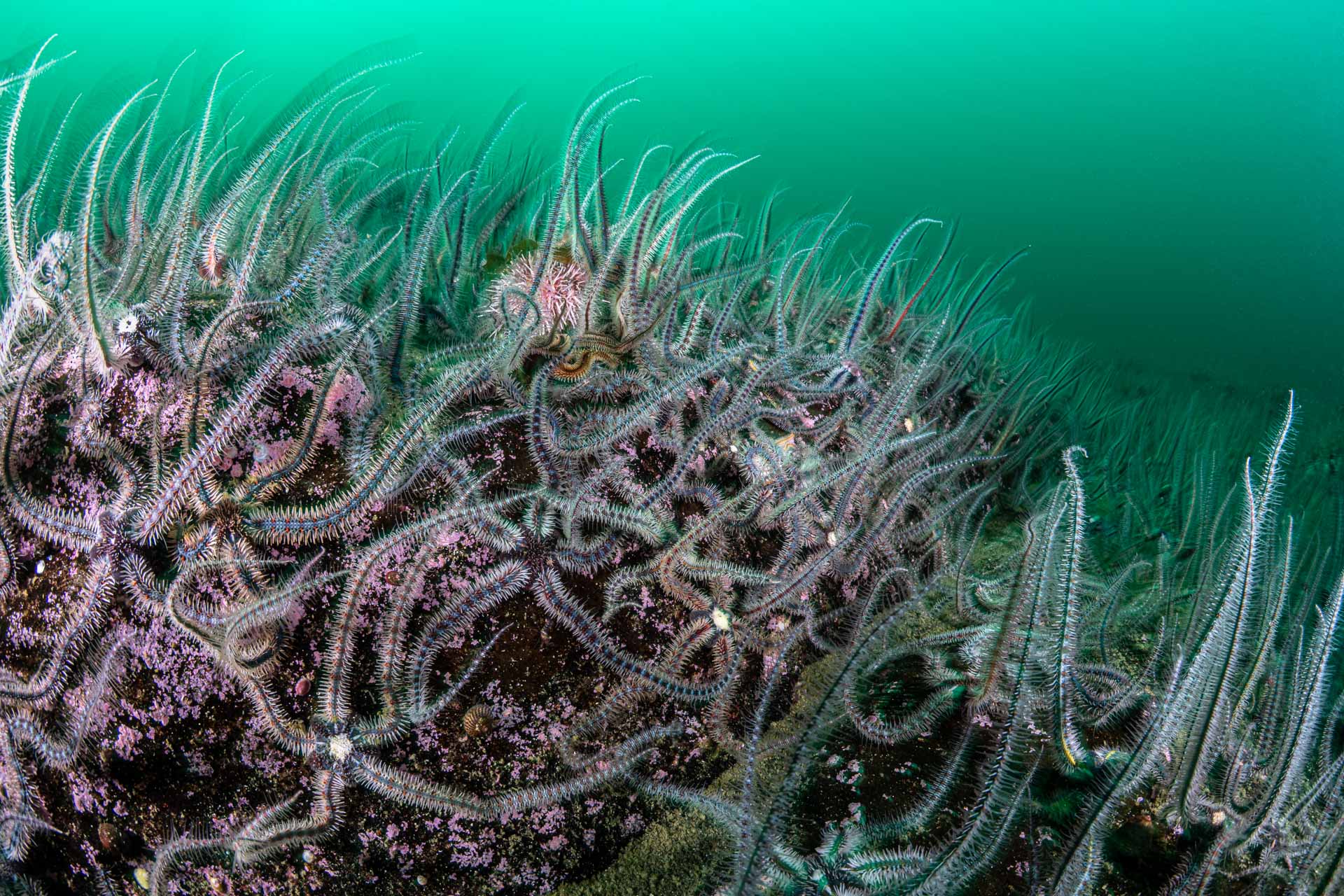
A dense aggregation of brittle stars with arms raised in suspension feeding posture.
Shifting baselines
One of the paradoxes of the English MPA network is that Marine Conservation Zones were created to restore the seas to health, but then not given the protection needed to do the job. We got into this crazy situation because well-meaning scientists were fooled by shifting baseline syndrome. This is a kind of intergenerational amnesia in which younger generations come to view degraded habitats as normal and natural, failing to appreciate that they were richer and more prolific in the past.
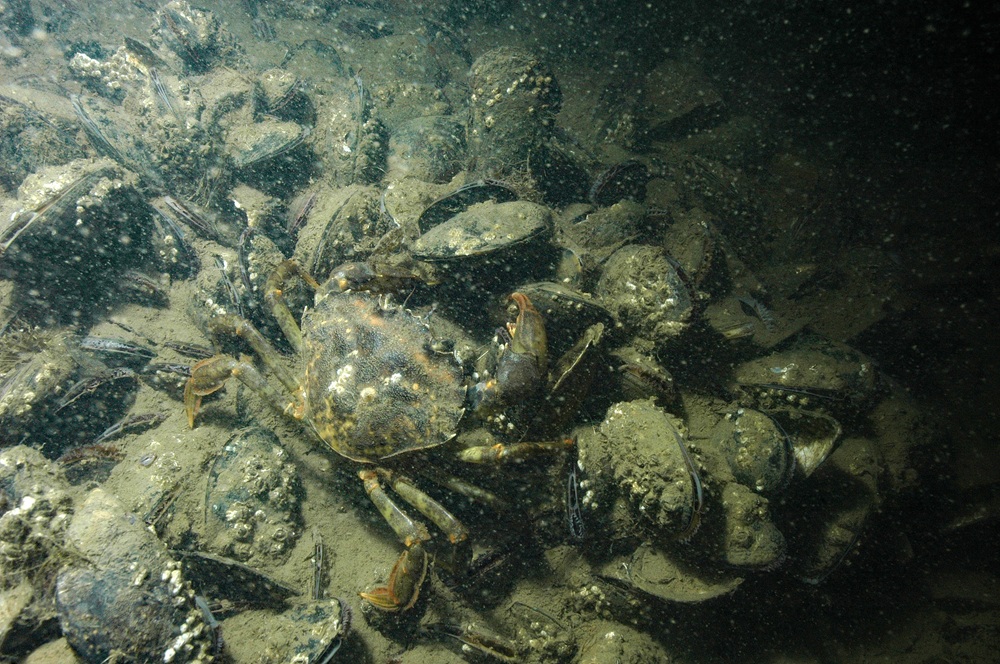
A mussel bed in the Tamar estuary, Southwest England.
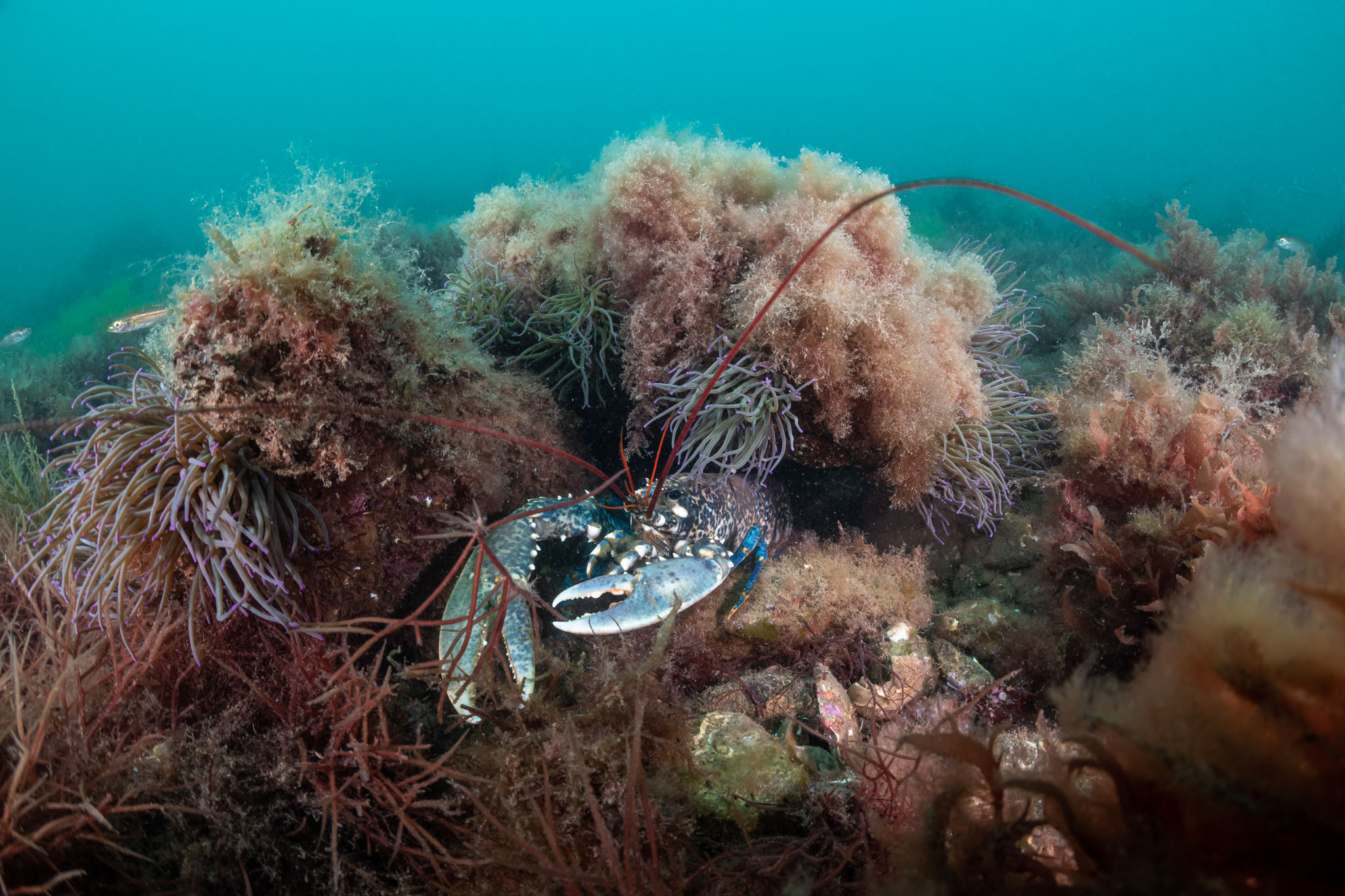
In a highly protected area, animals become bigger and more abundant.
In judging what nature needs from protection, we badly misread it. The seas around the UK have been impacted by industrial fishing and other activities for at least 200 years. Bottom trawling and dredging, in their initial phases in the early 19th century, swept away biogenic habitats such as oyster reefs and mussel beds, that covered tens of thousands of square kilometres of the seabed.
Most of those habitats no longer exist. Instead, we’re surrounded by shifting sands and gravels dominated by mud-dwelling worms, crabs, and molluscs. Are these areas resilient to bottom trawling? The answer is clearly yes, because the only things that can survive there have to be.
If trawling were to cease, a different seabed community would establish itself. Nature protection is about permitting recovery but the UK’s MPA network is incapable of doing so until the fundamental paradigm is changed.
Instead of protecting what is there now, we need to consider what an area of sea is capable of when given real protection.
Historic archives
Dr Ruth Thurston of the University of Exeter, together with a large group of researchers across Europe, reconstructed the history of oyster reefs. Descriptions from 200 and more years ago revealed dense, three-dimensional aggregations of animals supporting a great diversity of life. By the late 19th century, the reefs had largely disappeared, replaced by oysters scattered over the seabed: a shifted baseline even then. Significantly, the shift in the nature of the seabed happened way before living human memory.
Squeeze or spillover
Increasing competition for use of ocean space is felt acutely by fishers. However, establishing a network of protected areas supports healthy and productive fisheries, producing gains, not just costs for the fishing industry.
We can regard marine protected areas as protected sources for replenishment of populations. In a highly protected area, the animals inside become bigger, more abundant, and
more reproductively active. Most commercially important species have an early life stage as planktonic eggs or larvae which can drift long distances and replenish populations in the fishing grounds. Furthermore, animals in protected areas will experience more crowded conditions and competition, and will begin to move out into the surrounding areas. Both mechanisms of replenishment and spillover have been thoroughly demonstrated by science, and their fisheries support function is well proven for animals as dissimilar as lobsters and tuna.
Monitoring MPAs
Compliance in small-scale, coastal protected areas in relatively intensively used areas is dependent on regional fisheries management bodies and local scrutiny and surveillance. Monitoring enormous marine protected areas in the middle of an ocean requires entirely different approaches.
There have been rapid advances in the technology and capacity to watch activities from space. The movements of vessels at sea are routinely tracked, for navigation and safety purposes, by coastal authorities using the automatic identification system that sends the position of the boat to a satellite. But not all boats want to be seen on the open ocean.
The reason is that they’re undertaking clandestine activities such as fishing illegally in a protected area. By using satellite-borne synthetic aperture radar, this ‘dark fleet’ can also be detected. Figuring out the identity of a vessel and then tracking it back to port is another challenge, but it is becoming much harder to hide in these large-scale protected areas.
Trawling within marine protected areas
Trawling is an industrial activity that is highly destructive of biodiverse and productive habitats built by marine organisms. Should trawling take place in marine protected areas? Absolutely not.
The honest choice is to ban trawling and dredging from protected areas or take those areas off the statute books. There is no middle way: protected areas that are not protected from trawling and dredging are not delivering nature protection.
Areas beyond national jurisdiction: ‘the high seas’
We are reasonably well on course for protecting 30 per cent of waters under national jurisdiction by 2030. But protecting 30 per cent of the high seas means protecting a space that is double the size of all existing protected areas in the ocean and triple the size of all protected areas on land.
Up until now, and with the exception of the Antarctic, there has been no broadly agreed mechanism to establish marine protected areas in the high seas. The ratification of the Biodiversity Beyond National Jurisdiction Agreement (aka the High Seas Treaty) provides the framework to do that. Making the treaty work, so that it delivers a network of protection like the ones we have been building in coastal waters, will be an enormous challenge.
Alongside this challenge comes an opportunity for the global community to come together and cooperate to create that network. The committees that will scrutinize and decide upon MPA proposals will be established this year, and environmental organizations and governments around the world then need to cooperate to put the proposals together. It is important that scientific and analytical capability is built into the High Seas Treaty, to enable it to understand how each of the proposed protected areas fits together as a whole, so that the network is more than the sum of its parts.
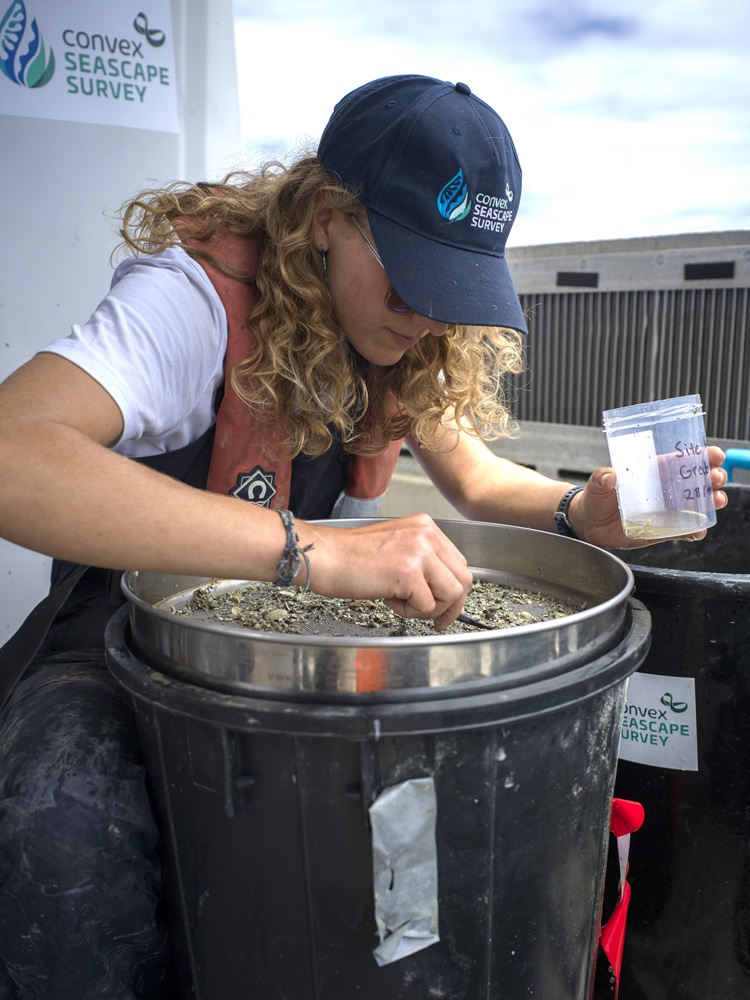
The Convex Seascape Survey team investigating benthic invertebrates.
Carbon
We need to protect the ocean not just for nature, but for the services that it provides to us, including a healthy climate system. We know that huge amounts of organic carbon are stored in ocean sediments. When they get stirred up by bottom trawling, port and harbour dredging, pipe laying for oil and gas platforms and so forth, some of that stored carbon is liberated and can potentially get back into the atmosphere and accelerate climate change. But so far, hardly any protected areas have been established for their blue carbon values, largely because mud is not seen as worth protecting for biodiversity reasons.
For a number of years I have been leading the Convex Seascape Survey project, which is trying to change these attitudes and give soft sediment habitats a makeover. The notion that these areas are resilient and robust to damage and that they’ll recover quickly from disturbance is mistaken.
Convex Seascape Survey is on an urgent mission to find out just how much carbon is being released from these sensitive and important environments, and how that disturbance is distributed across different industries.
Moving with the times
In the often polarized debate over marine protection, it is worth remembering that most of us seek the same outcomes: intact and productive habitats and healthy populations of marine life.
The fishing industry has unintentionally done immense damage to the marine environment over the course of centuries. We are at a point where we need to understand that damage and repair it. The way we fish at sea has to change because the environment is rapidly shifting under climate change, and an industry that adheres to the status quo is not going to be resilient to those changes. A more precautionary approach is needed that involves fishing less and using less destructive and more selective methods. And it means protecting a lot more space in the ocean. By putting together that package, we’re going to have a healthy, biodiverse ocean and productive, economically viable fisheries that will supply us long into the future.
- Professor Callum Roberts (C.M.Roberts@exeter.ac.uk), Professor of Marine Conservation, Centre for Ecology and Conservation, University of Exeter.
[1] Yes Minister is a British political satire TV sitcom, broadcast on BBC2 from 1980 to 1984.