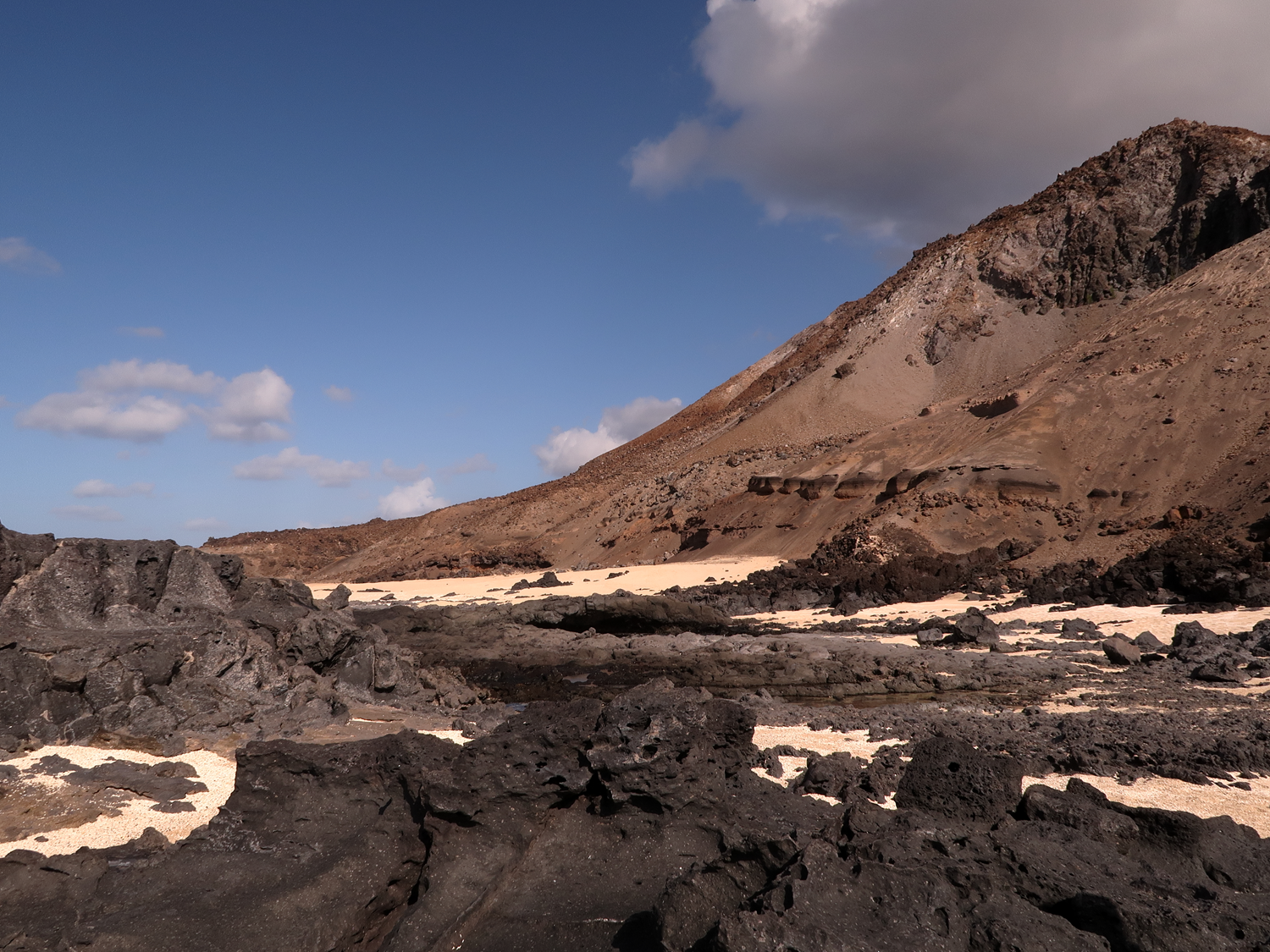
Arriving on Ascension Island, a UK Overseas Territory (UKOT) in the South Atlantic, is an extraordinary experience. Flying for hours over endless deep blue sea, you’re struck by just how isolated it is. And then it comes into view—arriving on this alien, red, rocky landscape has been likened to ‘landing on Mars’. The island is tiny at only 88 km2 but its waters extend to 445,000 km2. And, below those waters, it’s even more extraordinary, as nature has been conducting a giant experiment since the island started to emerge from the Mid-Atlantic ridge some 6 million years ago.
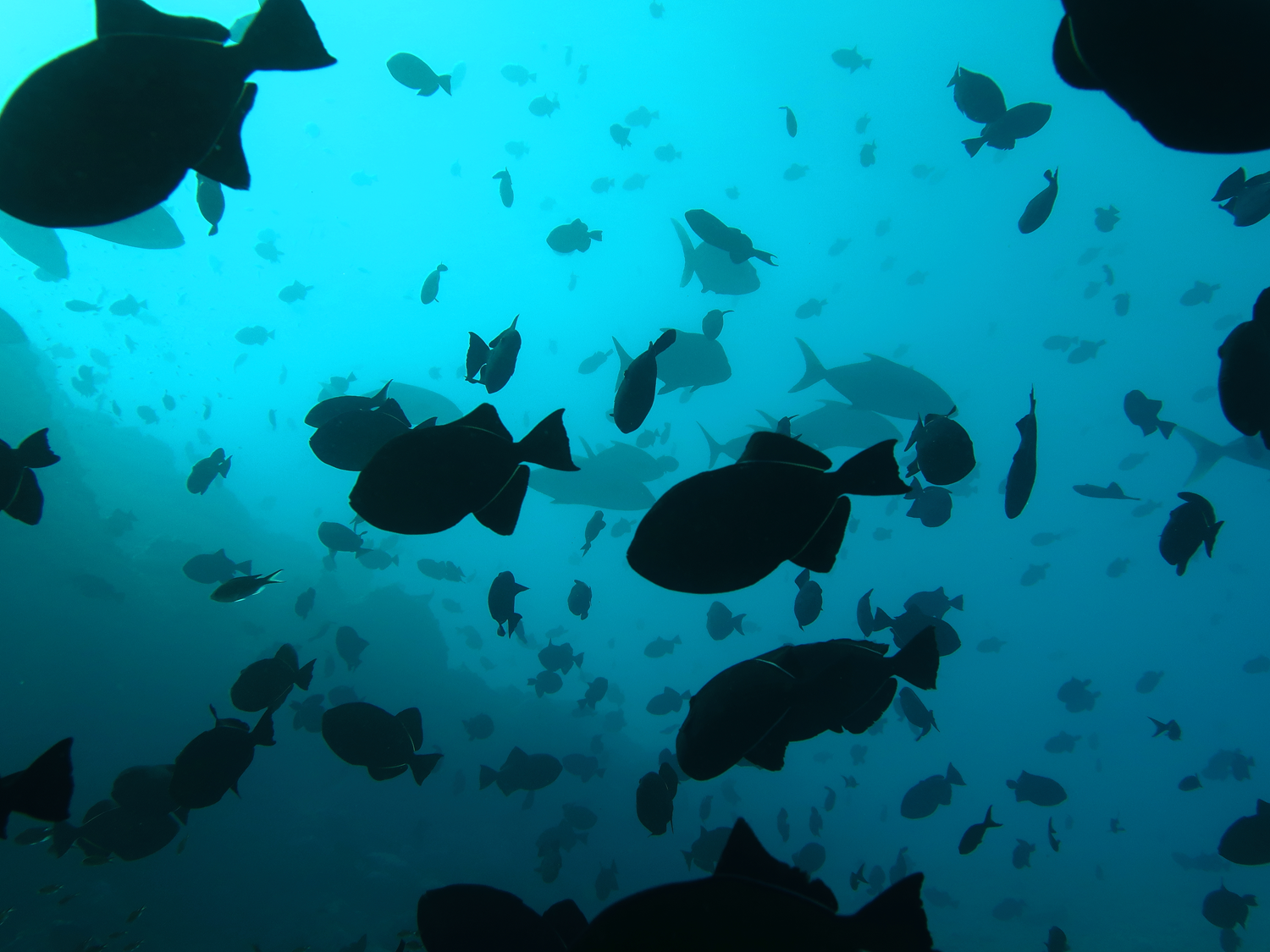
A shoal of black trigger fish (Melichthys niger).
Due to its isolation and location, there is a distinctive mix of Caribbean and West African species, and a high number of endemics found nowhere else on Earth. Its anchialine pools,1 covering an area of just 280m2, host a unique invertebrate assemblage with two species of endemic caridean shrimp and three endemic amphipods. And the island’s inshore waters are dominated by huge shoals of black trigger fish (Melichthys niger), which have taken on multiple ecological niches and scour the rocks clean. In the depths, hydrothermal vents host chemosynthetic microbes, and cold-water coral reefs serve as spawning grounds for tuna and marlin.
Combined, the 14 UKOTs host 94 per cent of the UK’s biodiversity, and much of that is marine. In 2016, the UK government launched the Blue Belt Programme to help UKOT governments to protect and better manage their globally important waters. Supported by the Programme, Ascension Island Government (AIG) began to gather evidence to inform decision-making on the location and extent of a proposed marine protected area (MPA). Some studies had been conducted within the 297 km2 of shallow waters around the island and its three main seamounts, as well as some limited tracking of mobile species. But 99.9 per cent of Ascension Island’s Exclusive Economic Zone (EEZ) is comprised of oceanic waters deeper than 500 m, with an average depth of 3,300 m; how could the Government account for its almost completely unknown deep-sea habitats in designating its MPA?
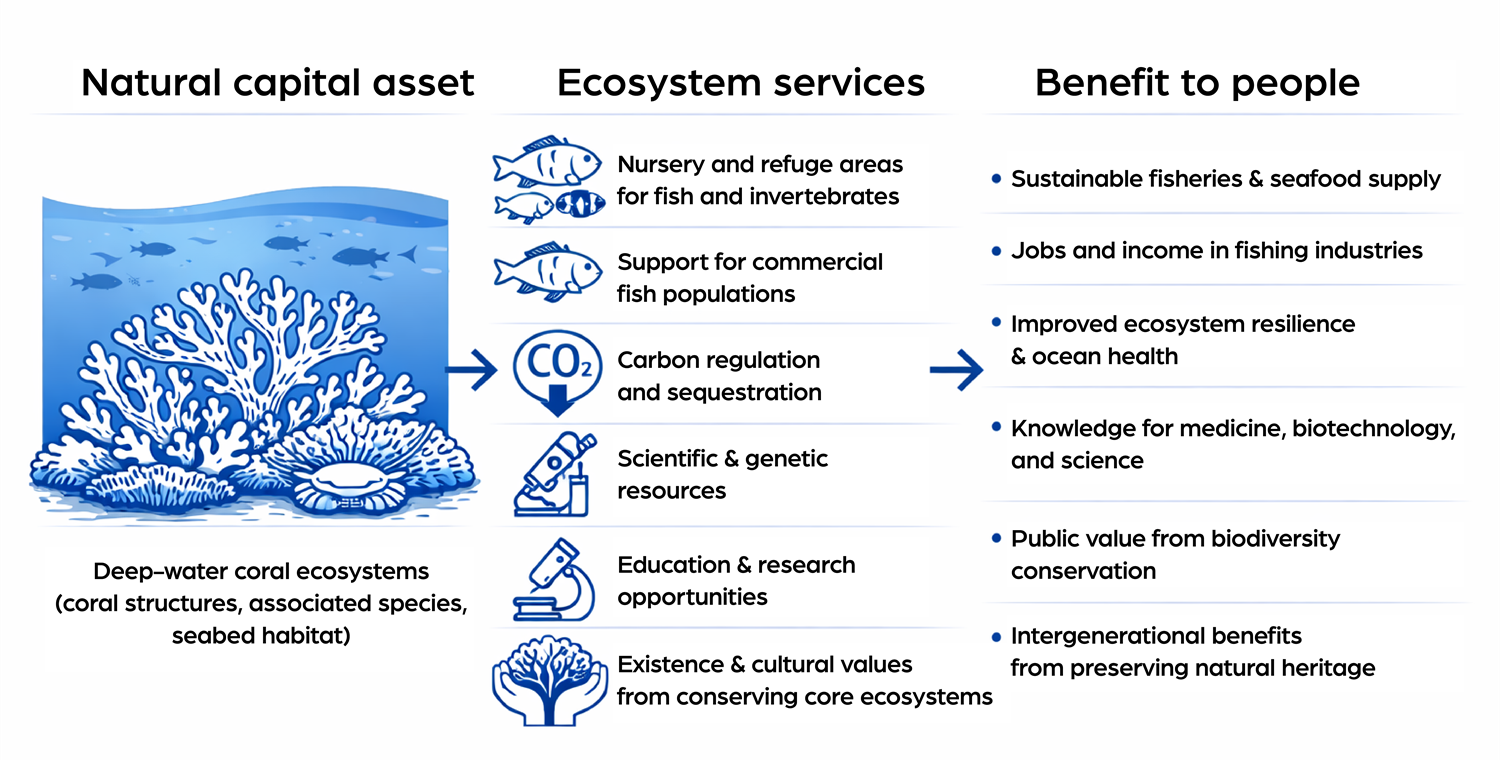
I was fortunate at this time to be running a UK Government funded project based with the South Atlantic Environmental Research Institute in the Falkland Islands. The project’s aim was to introduce natural capital approaches to the governments of the South Atlantic UKOTs and work with them to tackle policy and management issues through this lens. Marine natural capital assets are the ocean’s natural habitats, species, and ecosystems that provide ecosystem services, such as food provision and carbon storage, which in turn deliver social, environmental, and economic benefits to people (see diagram above). Through economic and social science methods, these benefi ts can be assigned monetary and non-monetary values.
In discussions with AIG’s Head of Conservation and Fisheries, I set out that taking such an approach and understanding the services provided by the island’s marine ecosystems would enable its deep-sea benthic habitats to be considered more equitably alongside the better-studied shallow ones. The Marine Biological Association and University of Plymouth were duly commissioned to conduct a natural capital assessment for the island’s entire EEZ.
The scarcity of data was a substantial challenge, and to identify likely deep-sea habitats, the assessment combined a review of available bathymetric and photographic data with a systematic literature review and expert consultations. The predicted habitats were attributed confidence levels and verified using a model being developed by a University of Plymouth PhD student, with good correlation. Associated ecosystem services were identified following the framework in an established marine spatial planning tool, and benefits classified into four categories. A further systematic review and expert judgement was used to populate a matrix detailing the likely contribution of ecosystem services from each habitat. A critical component of the research was a vulnerability assessment which set out the sensitivity of habitats to different human pressures alongside the likelihood of impact of those pressures. The final report formed part of the evidence base that resulted in designation of the entire 445,000 km2 EEZ as an MPA and was used to inform the MPA Management Plan and Biodiversity Strategy and Action Plan.
The report, and others from the South Atlantic Natural Capital project, continue to be used and referenced in the management of Ascension Island. Yet this is often not the case with natural capital studies, which often fail to meet the needs of decisionmakers. To ensure our research was fi t for purpose, we started bottom-up, by working with AIG, and asked an important question: what decisions will this need to inform? So much natural capital work starts with an idea, rather than a question. We have spent a long time testing natural capital concepts and methodologies and, although they have now emerged from academia and are being applied ‘in real life’, I believe we are still struggling to meaningfully integrate natural capital into policy and practice.
We’re also not very good at working with uncertainty in the Western world, where decisions are, rightly, held to account at the highest levels. Yet in the marine environment we are inherently dealing with uncertainty, especially in the deep-sea environments of our South Atlantic Overseas Territories. We’re uncertain what’s down there, and when we do know, we’re uncertain how these ecosystems function. And our valuation methods bring in yet more uncertainty. For example, how do you ask people what value they might place on an ecosystem and an island that few have heard of? It’s possible, but results, in my opinion, need very careful interpretation.
So, with this marine natural capital report for Ascension Island, we had to roll with the uncertainty and look at the bigger picture. Where data are scarce, all data are useful! We couldn’t create a definitive asset matrix, or look at the condition of those assets, or get anywhere close to assigning monetary values, all of which would typically be done for data-rich locations, but what we could do was provide AIG with the best available evidence of the types of assets and ecosystem services they were custodians of, and the activities that would endanger them. And it enabled them to consider and protect these deep-sea assets for generations to come.
Monetary valuation will always have a place in discrete, narrow trade-off decisions, and natural capital accounting is showing promise at a strategic level. But the process of finding creative solutions to address a lack of data has led me to consider how we might better integrate natural capital at a systems level into a world that still prioritizes economic growth. I’m leaning much more towards embracing multiple capital approaches that could use citizen juries to jointly agree the ‘relative value’ of assets for more equitable outcomes for people and the environment. It would mean a real shift in the current decision-making system, but there’s potentially great value in that!
• Ness Smith (nessiesmith@hotmail.com), Ness Smith Marine Consulting.
www.linkedin.com/in/ness-smith-33205813
www.linkedin.com/company/ness-smith-marine-consulting
With thanks to those who delivered the Ascension Island Marine Natural Capital Assessment: Giulia La Bianca, Heidi Tillin, Ben Hodgson, Gabriel Erni-Cassola, Amelia Bridges, Kerry Howell, and Sian Rees, and to Dee Baum, then Ascension Island Director of Conservation and Fisheries, and the South Atlantic Environmental Research Institute (SAERI).
Further reading
Brickle, P. et al. 2017. Biodiversity of the marine environment around Ascension Island, South Atlantic. Journal of the Marine Biological Association of the United Kingdom, 97(4):643-646. doi:10.1017/S0025315417001175 JNCC 2019. Overseas Territories – Natural Capital in the South Atlantic. jncc.gov.uk/our-work/natural-capital-in-the-southatlantic- overseas-territories
La Bianca, G. et al. 2018. Ascension Island Natural Capital Assessment: Marine ecosystem services report. Prepared for the South Atlantic Environmental Research Institute (SAERI). Marine Biological Association of the UK and University of Plymouth. UK Government 2025. The Blue Belt Programme. www.gov.uk/ guidance/the-blue-belt-programme