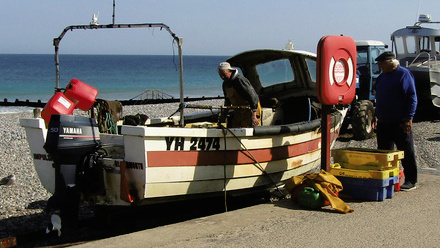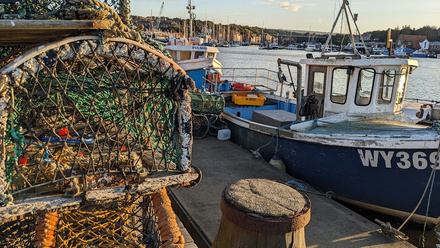
Main image: Fishing boats in outer harbour, Folkestone. Tim Sheerman-Chase, CC BY 2.0 <https://creativecommons.org/licenses/by/2.0>, via Wikimedia Commons
The inshore and small-scale fisheries sector is under pressure from declining fleet numbers, environmental change, competition from larger vessels, regulatory complexity, and ecological stress on stocks and habitats. To address these challenges, England’s Inshore Fisheries and Conservation Authorities (IFCAs) have statutory responsibility for managing inshore fisheries with sustainability and conservation objectives, while balancing competing interests (commercial, recreational, conservation). Their work is supported at the national level by the Association of Inshore Fisheries and Conservation Authorities (AIFCA). More recently, collaborative research and engagement efforts such as the ISSF/Coastal Fisheries Cluster (NICRE) have helped to surface systemic problems, identify priorities, and build consensus across stakeholders.
The role and functions of IFCAs
The Marine and Coastal Access Act 2009 (MaCAA) introduced a new framework for managing the sustainable exploitation of sea fisheries resources, to further the conservation objectives of Marine Conservation Zones (MCZs) and provide greater access to the marine environment. This Act of Parliament created Inshore Fisheries and Conservation Authorities (IFCAs) and is fundamental to their work.
Each IFCA covers a defined coastal district (out to 6 nautical miles). There are 10 IFCAs in England. In performing their duties, IFCAs must balance: social and economic benefits of fishing; protection and recovery of the marine environment; the needs of different fishing sectors, and sustainable development considerations. They must also further the conservation objectives in MCZs and other protected areas (e.g. European Marine Sites, SSSIs extending into marine waters) within their jurisdiction.
IFCAs create and enforce fisheries byelaws (seasonal closures, gear restrictions, spatial closures, catch or size limits) specific to their districts.
In co-operation with other organizations, IFCAs conduct or commission research and survey work including habitat mapping, stock assessments, fishery monitoring (e.g. landings, effort, gear use), and underwater imagery, to inform the evidence base for fisheries management. They collect local knowledge from fishers and use that in co-management. This evidence underpins adaptive management: adjusting measures in response to new information, trends, or environmental change.
A central part of IFCA work involves engaging with fishers and other stakeholders to design and implement appropriate and supported management measures. IFCAs operate under a co-management ethos, seeking to include user input (especially from small-scale fishers) in decision making. Public consultations, workshops, stakeholder committees, and meetings help align local knowledge with regulatory needs.
While IFCAs have considerable responsibilities, there are several challenges, including but not limited to: funding and capacity constraints, increasing duties, data deficiencies and stock uncertainty, transboundary and connectivity issues at the same time balancing conflicting stakeholder demands all whilst maintaining visibility and legitimacy. IFCAs rely on local authority contributions and DEFRA’s area-based grants and in view of the issues outlined, delivering all tasks effectively is a challenge. Nonetheless, academic and policy reviews find that IFCAs have contributed significantly to more locally responsive, accountable, and conservation-oriented management of inshore fisheries in England.
The role of AIFCA (Association of Inshore Fisheries and Conservation Authorities)
While each IFCA is regionally focused, there is a need for coordination, representation, and knowledge sharing at a national level. That is the domain of AIFCA.
The principal objective of AIFCA is to provide representation and support for the 10 regional IFCAs in England. AIFCA advocates for IFCAs in national policy, government consultations, and funding negotiations. The AIFCA helps coordinate national objectives, consistency in approach, and best practice sharing across IFCAs consistent with the IFCA vision.
In short, AIFCA plays an essential bridging role: between local and national government, between regional IFCAs, and between the IFCA network and external stakeholders.
The Inshore and Small-Scale Fisheries (ISSF) work and its significance
In recent years, growing concern about the decline of small-scale fishing led to a collaborative project that brought together academia, IFCAs, fisheries associations, conservation NGOs and other stakeholders. The aim is to deepen collective understanding of the drivers behind fleet decline, and to identify interventions that might support sustainable fisheries livelihoods.
In England this work is packaged under the Coastal Fisheries Cluster led by Newcastle University and supported by NICRE, in which IFCAs and AIFCA have been active participants.
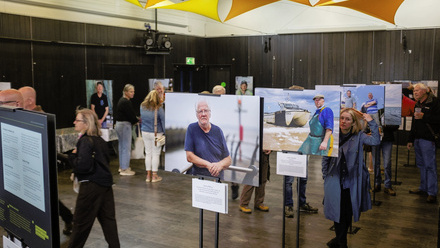
The work has included national workshops (Poole and Whitby, autumn 2024), research outputs (policy briefs, reports), photography exhibitions (‘Pride in our Seas’), and regional engagement events planned for 2025 and 2026.
Key outputs findings, priorities, and recommendations of the ISSF consortium were shared with parliamentarians, policy makers, and stakeholders (through a Parliamentary event hosted by AIFCA in March 2025 and are covered in this special edition.
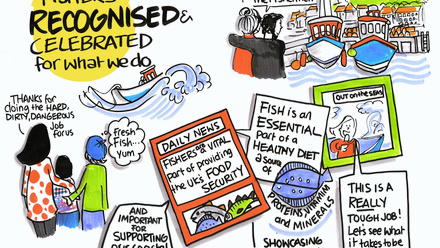
The consortium emphasizes that securing small-scale fisheries is not just about ecological sustainability; social, economic, and cultural dimensions must weigh equally.
Bringing it all together
The consortium’s work helps to amplify the voices of small-scale fishers, while the priorities identified point directly to areas where IFCAs and AIFCA can act, for example, adjusting health and safety regulations, streamlining regulatory burdens, targeted support or grants for small vessels, and enhancing capacity building. It also strengthens the rationale for co-management, stakeholder inclusion, and adaptive regulatory frameworks tailored to small-scale operations.
The national convening and workshop approach helps build shared understanding and consensus across regions, which AIFCA and IFCAs can leverage to coordinate cross-district responses to shared challenges.
To secure inshore and small-scale fisheries in England effectively, the institutional system works at multiple levels (see Box). In practice, success depends on integration: IFCAs need good science, fisher buy-in, enforcement capacity, and adaptive authority. AIFCA needs effective representation and resource leverage. The ISSF-style work must remain grounded in fishers’ realities.
BOX. How all the pieces fit
- IFCAs are the frontline managers, implementing local regulation, enforcing compliance, engaging stakeholders, and adapting to changing ecological and social conditions.
- AIFCA acts as the national coordinator, advocate, and capacity multiplier; it elevates local experience into national policy space, supports consistency, and enables economies of scale in functions otherwise out of reach for individual IFCAs.
- Collaborative research and stakeholder engagement initiatives such as the ISSF feed evidence, legitimacy, and direction into both IFCA-level and national-level decision-making. They help to identify shared priorities, check assumptions, and mobilise stakeholder consensus.
This system faces constraints—funding, data gaps, enforcement limits, shifting marine ecosystems, but by combining local legitimacy, national coordination, and evidence-based engagement, there is good potential to sustain and restore a viable inshore fisheries sector.
Robert Clark FMBA (robert.clark@association-ifca.org.uk). Chief Officer Association of IFCAs.