QUAYSIDE CONVERSATIONS
As documented by Sarah Coulthard, November 2025[1]
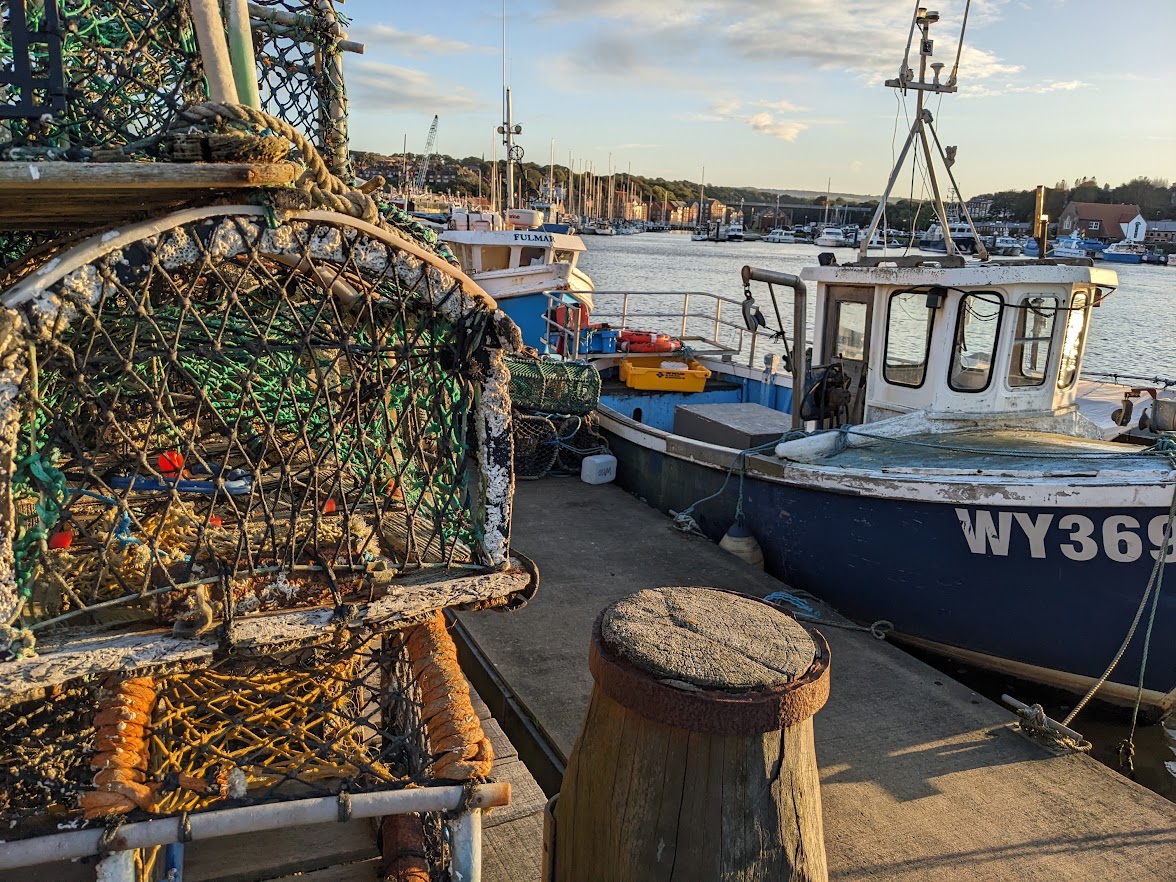
We sit down, crowded into the snug of a pub in Whitby, a town on the east coast of Yorkshire that still boasts an active fishing industry, but one that is heavily dependent on crab and lobster. The conversation starts about recent catches. Pictures on mobile phones are shown around of lobsters landed, large ones, tiger ones, green ones… then we start to talk about the realities of a fishing life in the town.
John opens the conversation: ‘Fishing is what Whitby was built on, but it’s been left in the past now. People try to grow Whitby, but they forget about the fishing. People want to keep the image of fishing…’
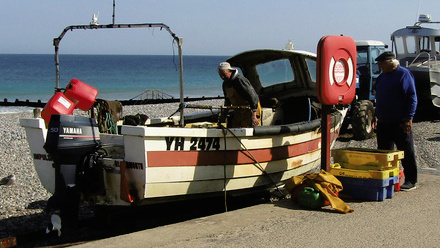
Chris: ‘they’d probably like to see a cobble [a traditional small wooden fishing boat] sailing once a day with a bunch of fishermen in oil skins all singing…. But for fishermen, it’s their whole life’
David: ‘It’s not instilled into you—you’ve got to want to fish, you’ve got to get up at stupid o’clock every morning, and then do it again and again…. You’ve got to have a good crew to do it’.
Matt: ‘That’s why I go on my own, because I get more freedom then, less people reliant on me, and getting a good crew is getting harder and harder…’
David: ‘I started at 12 years old. All summer I’d fish for my father who went to sea, and I’d follow and I wanted to do it, and the lads around me wanted to do it too, but it’s not like that any more. You can go on an oil rig in the North Sea and earn twice as much money now. You’ve got a minimum wage these days. A paid share on a boat is less attractive. You used to have lads coming through and fishing was all they wanted to do, but now they’ve put in all these rules and regulations that make it so hard…. You’ve got expenses, insurances, bureaucracy, landing dues … it’s all on the shoulders of the skipper’.
Chris: ‘It's come to the stage now where we won’t have any fishermen in a few years’ time …’.
David: ‘It’s collapsing, and do you know why? It’s an arms race here with crab pots and boats. Your crew see what you could earn and want their own boats; we’re all fishing against each other. With windfarm compensation fishermen are buying more and more pots. But it’s plateauing now and it’s going to go down. All the top men are selling up…. We need a pot limitation measure here [one is under consultation with the local NEIFCA]. Boats work thousands of pots. We used to work the pots every day, but some boats just leave their pots soaking for weeks at end and then lose them in rough seas. We wanted an 800 [per boat] pot limit’.
John: ‘I work fewer pots, but if I wanted to build and grow, there’s no space for me when others have got thousands. It should be 800 per boat, and out to 12 miles… or you’ll have a million pots behind the 6-mile line [the limit of IFCA jurisdiction]. I can’t go to my traditional fishing grounds as many fishermen have come out of trawling and moved into potting. Out there, there’s just fleet after fleet after fleet—they’re just killing it with too much gear. Further out, people have been pushed off their grounds due to a new pipeline coming in. They get compensation to move off their grounds but then come inshore and fish on top of me. I didn’t get a grant or anything to help. I’m just a single lad [single-handed boat], I’ve got a family at home; this is my livelihood. There have been times when someone’s shot a fleet of pots on top of me, and I’m going out in weather I shouldn’t be going out in because I’ve only got a little boat, but I’m having to fish in deeper waters. It’s scary’.
Matt: ‘I might haul one fleet of 15 pots, get 11 or 12 big decent lobsters, but the next minute there’s another and much bigger boat right next to me shooting the same grounds. We’re being squeezed together’.
David: ‘The thing that would make the biggest difference to sustaining fisheries is to restrict the EU longliner and netting vessels. I’ve worked nets, and we used to work them like we do pots, but there’s now 30, 50 miles of net. One of them broke down and it was everywhere on Facebook. They’d been left for weeks. Do you know what happens in a left net? They cause carnage. A proper fisherman would not leave his gear. You work and tend your gear and take it home’.
This is just a small insight into some of the challenges faced, many of which are reflected in the Inshore and Small-Scale Fisheries priorities, distilled through the Whitby and Poole workshops in 2024.
Dr Sarah Coulthard (sarah.coulthard@ncl.ac.uk), Newcastle University
[1] All names are pseudonyms to protect the anonymity of fishermen as per Research Ethics approval Reference 61502/2023 Newcastle University.